

Does Inner Silence Still Frighten You?
Serge Dumont


There is a question we rarely ask ourselves...
Not when we're alone.
Not when we're tired.
Simply when there's nothing left to watch, nothing left to listen to, and nothing left to do for a few minutes.
Most of us already know the answer.
Without even realizing it, we reach for our phone.
We open an app.
We put on some music.
We start a podcast.
We reply to a message.
We find something to do.
And if nothing presents itself, our mind takes over.
It replays a conversation.
It prepares for tomorrow.
It imagines different scenarios.
It jumps from one thought to another.
As if it stubbornly refused to remain still.
What happens when nothing is left to occupy our attention?
For a long time, I believed this meant we were afraid of silence.
Today, I think that idea is incomplete.
Silence May Not Be the Absence of Noise
We often associate silence with a quiet place.
A peaceful room.
A forest.
A library.
And yet you've probably experienced the opposite.
Walking through nature, surrounded by the wind, birdsong, and the sound of a flowing river, while feeling a profound inner silence.
Or, on the other hand, finding yourself alone in a perfectly quiet house... with a mind that simply won't stop.
That reveals something important.
Silence isn't merely about the absence of sound.
It's a way of being present with what is happening within you.
In other words, the opposite of noise isn't always silence.
Sometimes… it's listening.
We've Become Remarkably Skilled at Avoiding Empty Spaces
This isn't a character flaw.
Nor is it a lack of willpower.
It's simply a habit we've developed, almost without noticing.
Think about an ordinary day.
You're waiting a few minutes before an appointment.
You reach for your phone.
You get into your car.
You turn on some music.
You're cooking.
You play something in the background.
You're walking.
You check your messages.
These actions have become so natural that they're almost invisible.
And there's nothing inherently wrong with them.
Music can move us.
A podcast can teach us something new.
Technology offers us countless benefits.
So their existence isn't the problem.
The problem begins when they systematically fill every space.
As though emptiness itself had become something that needed to be fixed.
A Civilization That Leaves Little Room for Silence
For most of human history, moments when nothing happened were simply part of life.
People walked.
They waited.
They observed.
They allowed a thought to unfold all the way to its end.
Today, it takes only a few seconds to erase those moments.
There's always something to check.
Something to hear.
Something to produce.
We're probably the first generation capable of eliminating almost every moment of waiting.
That may seem insignificant... I don't believe it is.
Because empty spaces once served a purpose.
They gave us time to absorb the day.
To let an emotion settle.
To reflect.
To create.
To simply do nothing.
And perhaps we're only beginning to discover what their disappearance is changing within our inner lives.
Maybe It Isn't Silence We're Avoiding
People often say:
"You're afraid of being alone with yourself."
Can you still choose?
There is some truth in that… But I think the explanation stops too soon.
I believe something else is happening.
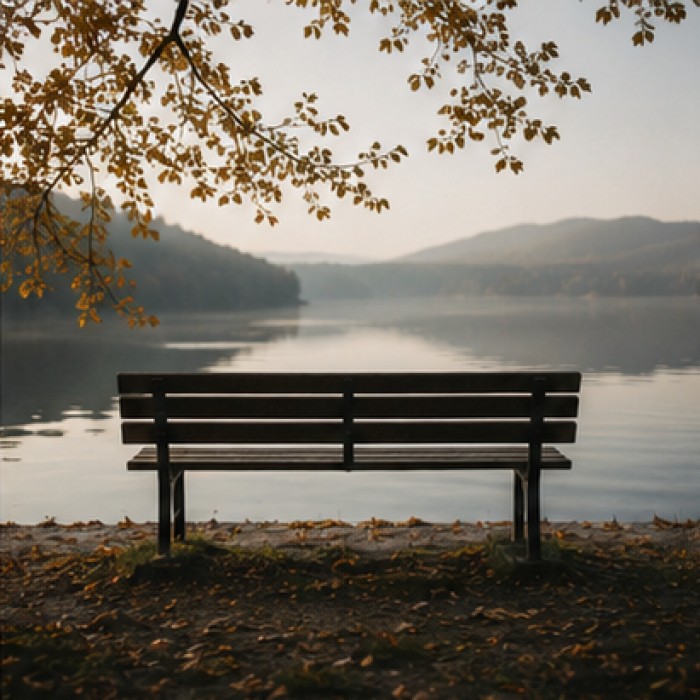
Imagine a lake whose surface is constantly disturbed by the wind...
You can't see the bottom.
Then the wind suddenly dies down.
The lake doesn't add anything.
It simply stops hiding what was already there.
Silence often works the same way.
It doesn't create our worries.
It doesn't create our questions.
It doesn't create our emotions.
It gradually removes what had been occupying all of our attention.
And suddenly, certain realities become visible again...
A fatigue we've been pushing aside for weeks.
A decision we've been avoiding.
A relationship that no longer feels true to who we are.
A sadness that's been waiting a long time to be acknowledged.
A desire to create that we keep postponing.
Silence doesn't bring these things into existence.
It simply stops covering them.
Your Brain Doesn't Like Empty Space
There's also a very simple explanation for this reaction.
Your brain is an extraordinary information-processing system.
When it no longer has an external task to focus on, it doesn't stop working.
Quite the opposite.
It revisits the past.
It prepares for the future.
It searches for solutions.
It imagines different scenarios.
It tries to make sense of your experiences.
In other words, when you sit quietly and your mind becomes restless, it doesn't mean you're failing.
You're simply watching your brain do what it was designed to do.
That understanding changes everything.
It replaces judgment with curiosity.
Instead of thinking,
"I can't handle silence."
You can begin asking yourself,
"What is my mind trying to resolve right now?"
It's a far more fruitful question.
Not Every Discomfort Is a Wound
I'd like to add an important nuance.
Personal development sometimes gives the impression that every uncomfortable feeling hides a trauma or a deep emotional wound.
Reality is often much simpler than that...
Sometimes silence merely reveals that we're tired.
Or that we need to slow down.
Or that we've drifted away from what truly matters to us.
Sometimes it reveals nothing in particular.
And that's perfectly okay.
There's no need to search for a hidden meaning behind every emotion.
Silence isn't a detector of emotional wounds… It's simply a space where certain realities can finally be heard, when they genuinely exist.
Rediscovering the Freedom to Choose
This isn't about living without music, without your phone, or without distractions.
Nor is it about turning silence into another obligation.
The question is much simpler.
Can you choose to listen to a podcast because you genuinely want to?
Or choose to take a walk without listening to anything at all?
Can you choose to watch a movie simply because you enjoy it?
Or allow a quiet evening to exist without immediately feeling the need to fill it?
Freedom doesn't mean eliminating distractions… It means no longer depending on them.
An Experiment
I'm not going to suggest a thirty-day challenge.
I'd rather invite you into something much simpler.
Today… Take «five minutes».
Sit somewhere you won't be interrupted.
Don't try to meditate.
Don't try to quiet your mind.
Simply observe what happens.
And every time you feel the urge to reach for your phone, get up, or distract yourself in some way, ask yourself one simple question:
What was I hoping to avoid during the next thirty seconds?
Don't expect a profound revelation.
Sometimes the answer will simply be:
"Nothing... It's just a habit."
Other times, you may notice anxiety.
A fatigue.
An impatience.
Or simply the urge to move.
Whatever you discover...
Welcome it with curiosity.
Not with judgment.
Perhaps Silence Isn't Asking Anything of You
We spend much of our lives listening to the world.
To other people's expectations.
To the news.
To notifications.
To responsibilities.
To endless urgencies.
All of these naturally occupy our attention.
But there is another voice...
One that sometimes becomes almost impossible to hear.
Our own.
Not the voice that criticizes.
Not the one that compares.
Not the one that endlessly anticipates.
The other one.
The one that recognizes a limit before exhaustion.
A need before it becomes deprivation.
A joy before it gets postponed yet again.
Silence is neither a refuge nor a trial… It's an appointment.
Perhaps, deep down, silence doesn't frighten you.
Perhaps it isn't asking anything of you at all.
The choice is yours.
You can keep postponing that meeting… Or you can finally discover why it has been waiting for you all this time.
"We believe silence is empty. In reality, it's often… the first place where we finally stop running from ourselves."





These themes are explored in greater depth in my personal development and self-therapy books.
This reflection also aligns with the vision presented in my Editorial Philosophy.
Furthermore, to better understand the journey that informs these writings, you can read «Getting to Know Me.»