

What triggers anxiety... and How can I respond differently ?
Serge Dumont
Anxiety rarely comes out of nowhere...
It is usually triggered by something… a tone of voice, an unanswered message, an uncertainty about the future, a memory we didn’t even realize was still living inside us.
For a long time, I believed anxiety meant something was wrong with me.
I tried to push it away.
Control it.
Override it.
But I’ve come to understand something gentler:
Anxiety is not the enemy… It is often a protector, reacting faster than our conscious mind.
The real shift began when I stopped asking,
«How do I get rid of this ?»
and started asking,
«What is being activated inside me right now?»
1. Understanding what’s actually being triggered
Most triggers are not about the present moment alone.
They awaken:
A fear of losing control
A fear of rejection
A fear of not being enough
A memory of past instability
When something feels disproportionately overwhelming, I now pause and ask:
«Is this about now… or is this about before ?»
That simple question creates space.... Anxiety shrinks when awareness grows.
2. Regulating the body before fixing the story
Anxiety is physiological before it is logical.
The heart speeds up...
Breathing becomes shallow...
Muscles tighten...
Trying to reason with anxiety while the body is in alarm mode rarely works.
So instead, I begin here:
Slow inhale for 4
Longer exhale for 6
Repeat for two minutes
Lengthening the exhale signals safety to the nervous system.
Sometimes the situation hasn’t changed, but my internal state has.
And that changes everything.
3. Responding instead of reacting
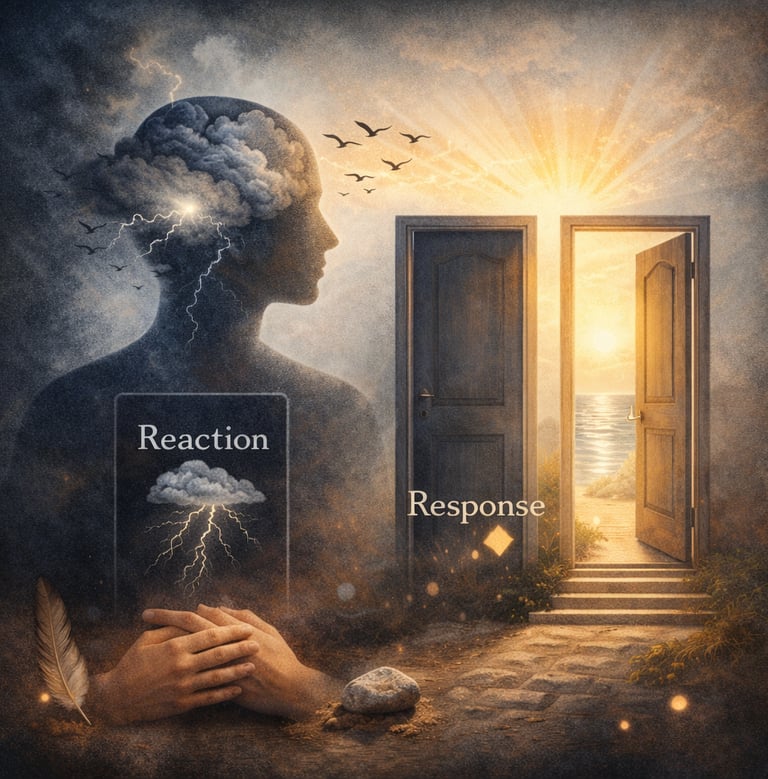
A trigger pulls us into reaction… But resilience grows in response.
When I feel anxiety rising, I gently ask:
What do I actually need right now?
Reassurance?
Clarity?
Rest?
A boundary?
Often, anxiety is an unmet need wearing a loud voice.
When I respond to the need instead of fighting the feeling, the intensity softens.
4. Releasing what I cannot control
This part changed my relationship with anxiety completely.
There is always a portion of reality I cannot control:
Other people’s choices
Outcomes
Timing
The future
When I try to control what isn’t mine to control, anxiety increases.
So I return to two questions:
«What is mine to act on ?»
«What must I release ?»
I do what I can with integrity… and then I consciously let go of the rest.
Sometimes I even say quietly:
«I’ve done my part. I trust the unfolding.»
It is not passive... it is grounded trust.
A gentle practice you can try
Next time anxiety appears, instead of resisting it, try this:
Name the trigger.
Breathe slowly for two minutes.
Ask: «What am I afraid might happen ?»
Separate what you can control... from what you cannot.
Take one small aligned action… and release the rest.
Anxiety often loses its grip when we meet it with awareness instead of fear.
Anxiety is not a flaw in your character.
It is a signal.
A protector.
A messenger.
And when you learn to listen differently, it becomes less of a storm and more of a guide.

These themes are explored in greater depth in my personal development and self-therapy books.
This reflection also aligns with the vision presented in my Editorial Philosophy.
Furthermore, to better understand the journey that informs these writings, you can read «Getting to Know Me.»